
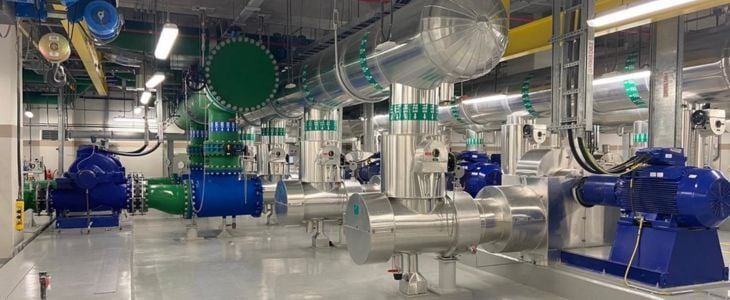
The centralized cooling plant regains prominence as hyperscale data centers strive to find solutions for a number of challenges ahead. From higher cooling demands and power densities to the need for scaling, redundancy and growing energy consumption limitations, these challenges are causing more and more operators to look at centralized paradigms as an answer.
With the rise of the hyperscale data center and the shift toward AI-ready data center infrastructure, choices around how to produce, distribute and manage cooling capacities are becoming increasingly strategic.

In this context, centralizing cooling production at a large scale can help solve the challenges by boosting efficiency, redundancy, and scalability, bringing in a number of advantages in cooling management that, in certain projects, are difficult to achieve within distributed infrastructures.
Building from ARANER’s expertise in developing efficient data center cooling solutions, let’s take a closer look at the potential of centralized cooling systems for hyperscale data centers.
The hyperscale paradigm is changing the economics of data center cooling
The renewed interest in centralized cooling systems is tied to the change in scale that is brought along by the needs of hyperscale data centers. Because with their bigger scale comes a necessary shift in the technical and economic frameworks required for designing data center cooling systems.
The changes in the hyperscale data center are signaling the need for increased data center cooling efficiency are multiple:
- The rise of energy demand by data centers, led in part by AI data center power demand and the needs of High-Performance Computing (HPC). As an illustration, the IEA estimates electricity consumption from data centres amounted to around 1.5% of global electricity consumption in 2024 but will rise to 3% in 2030, a growth largely driven by the rise of AI and HPC.
- The increase of rack densities, with higher and more concentrated thermal loads.
- The need for scaling up capacities gradually, meeting potential facility growth.
- The limitations in electricity availability in certain locations.
- A growing focus on efficiency when it comes to data center performance parameters, with work by entities like The Green Grid increasingly taking center stage in data center discussions.
- Requirements to guarantee service availability and redundancy, positioned by entities such as ASHRAE as a fundamental piece of reliable, efficient data center cooling.
Working in synergy, these shifts are transforming the needs of the hyperscale data center at a fundamental level: while they put a strain on these projects’ capacities for efficiency from an energy and economic perspective, they also call for new approaches in data center cooling plants that are aligned with these new realities.
Why centralized cooling plants are finding new relevance in hyperscale design
Efficiency gains become more significant at scale
The advantages of this type of cooling plant stem from the model’s centralized approach: a type of infrastructure that allows for a unified management of cooling infrastructure, including chillers, pumps and other equipment, and one that is tied to cooling demand.
So that, while data center cooling efficiency gains can also largely depend on optimized cooling infrastructure and operational conditions, there are a number of conditions in a centralized cooling plant that position it as a favourable model:
- Allows for part-load efficiency scenarios.
- Can activate equipment sequencing.
- Facilitates optimizing chiller operation.
- Can adapt cooling production to demand.
As a whole, when well-designed and after studying whether it responds to the project’s needs, the centralized cooling plant can thus allow for optimizations that go beyond cooling and are applicable at a system level.
Cooling capacity can scale with the data center
The capacity for scaling represents another key reason why centralized cooling systems are receiving attention in the context of hyperscale data centers. Here, this centralized approach to data center cooling infrastructure can be designed to accompany the gradual growth of the hyperscale campus, effectively solving the scaling challenge.
From this point of view, centralized paradigms do not necessarily imply building the center’s total future capacity from the beginning: the cooling project can adopt a modular architecture, so that it extends as needed, when new buildings, data halls or IT loads enter the picture.
Centralization improves redundancy and operational flexibility
The 2025 Annual Survey by Uptime revealed how working on redundancy and minimizing downtime is now a major strategic goal for data centers: 57% of the survey respondents said their most recent major outage cost more than $100,000.
In this context, centralized cooling plant architectures can also improve redundancy and flexibility by sharing cooling capacities between different loads. An important step forward at a time when uptime and operational continuity are fundamental for hyperscale data centers.
Here, a well-designed centralized data center cooling infrastructure introduces built-in redundancy through several important opportunities, including the possibility of activating shared standby capacity, equipment rotation and load redistribution by employing shared spare equipment: so that, instead of replicating distributed units for N+1 and N+2 redundancies, the centralized model strategically activates shared equipment as needed.
A possibility that also opens the door to maintenance operations that don’t imply stopping cooling availability as a whole, therefore taking redundancy and flexibility to the next level.
Central plants enable more sophisticated energy management
The centralized cooling plant also enables opportunities for cooling to be managed as part of a data center’s overall energy strategy. A possibility that broadens the perspective so that the point is not simply to efficiently cool a data center, but to manage cooling infrastructure and energy infrastructure together for achieving greater efficiencies as a whole.
This is because centralized models bring about the potential of incorporating sophisticated energy management strategies that prioritise efficiency, including:
- Thermal Energy Storage for load shifting and optimized peak demand management.
- Optimization strategies for chiller operation.
- Improved management of electric demand.
- Integration with the network’s availability in real time.
Thermal Energy Storage: the advanced strategy that transforms centralized cooling models
At the center of Thermal Energy Storage and the possibilities it enables is this technology’s capacity to partially decouple cooling production from consumption. In other words, thanks to TES technologies, the production of cooling and its consumption can happen at different times, instead of simultaneously.
By being able to store cooling energy, TES systems activate the following:
- The production of cooling during more favourable periods (for instance, when cheaper or more sustainable energy sources are available) that can then be stored and employed when needed.
- An optimized management of electric demand peaks.
- Load shifting scenarios.
- Optimized chiller operation.
- Expanded capacities for periods of maximum cooling demand.
By doing this, TES technologies are able to boost flexibility in the cooling plant, but their effects go further: they allow the centralized cooling plant to extend beyond its role as a cooling production facility and become a sophisticated energy-management asset for efficiency.
Distributed vs. Centralized cooling systems: a decision that is not binary
The increased attention that centralized cooling plants are receiving doesn’t automatically imply that all distributed cooling solutions are becoming obsolete.
In fact, modern hyperscale data centers can thrive by combining different technologies and thus accessing the advantages of each different paradigm, including central chilled water production, CRAH, data center liquid cooling systems and direct-to-chip cooling, CDU and diverse solutions for high-density racks
This is well illustrated when looking at how centralized cooling plant models and data center liquid cooling systems can coexist instead of being understood as competing paradigms. From this perspective, technologies used to capture heat [at the rack level] can evolve at their own pace and according to their own needs; meanwhile, the need to transport, manage and reject that heat at a plant scale can be designed centrally and respond to the facility’s requirements as a whole.
When does a central cooling plant make sense for a hyperscale data center?
As mentioned above, the centralized cooling plant is not the only solution for optimizing any hyperscale data center project: its relevance must be analyzed on a case-by-case scenario, considering each project’s needs, limitations and potential.
As such, there are certain contexts and project characteristics in a hyperscale data center that can signal a centralized cooling plant can potentially be beneficial, including:
- High cooling loads.
- Hyperscale campuses composed of several buildings.
- Projects that are developed and grow in different stages.
- High or variable thermal loads.
- High redundancy needs.
- Locations with limited electric availability.
- Projects where Thermal Energy Storage is being discussed.
- Data centers designed with expansion plans.
By evaluating these variables, it’s possible to understand what each project’s potential and requirements are, and whether or not its cooling architecture would benefit from opting for a centralized cooling plant.
From cooling infrastructure to strategic energy infrastructure
The renewed attention for centralized cooling plants in data centers reflects a broader transformation in how hyperscale data centers are understood and designed.
Today, it’s increasingly clear that cooling infrastructure should not be designed in a vacuum, isolated from other key aspects of the center’s architecture. Instead, its design must necessarily incorporate and work in synergy with factors such as power availability, energy efficiency, scalability and redundancy needs, potential grid constraints and even expected future IT loads.
This marks a move towards more mature and nuanced positions in data center cooling design where operators are no longer just preoccupied with how to remove heat: they now also incorporate a broader perspective by asking how to provide and manage cooling capacity efficiently while IT loads, energy constraints and even the facility itself keep evolving.
In this context, ARANER stands out as a key thermal engineering partner. Specialized in large-scale cooling infrastructure and Thermal Energy Storage solutions, we design data center cooling solutions that are aligned with the needs of large facilities and consider their specific thermal, energetic and operational needs.
Download our Data Center Whitepaper to learn more about how to optimize thermal performance in modern data centers and get in touch with our team to discuss your project and how we can help you.

Frequently Asked Questions about centralized cooling plants for hyperscale data centers
Why are centralized cooling plants becoming more relevant for hyperscale data centers?
Centralized cooling plants are gaining more attention because they can be useful in solving certain challenges now faced by some hyperscale data centers, including the rise of energy demand, the growing rack densities and higher and more concentrated thermal loads, and the needs that arise from scalability, redundancy and limitations in energy availability.
What are the benefits of centralized cooling systems for data centers?
Well-designed centralized cooling systems that are aligned with a project’s needs can imply a greater efficiency (thanks to a unified management of cooling infrastructure), greater opportunities for scaling, improvements in redundancy and flexibility and the capacity to integrate cooling within more sophisticated, global energy management strategies.
What is the difference between centralized and distributed data center cooling?
Centralized data center cooling is designed to meet the cooling demands of the whole infrastructure from a single point, so that it integrates chillers, pumps and other equipment for producing and managing cooling in a unified location. This differs from distributed architectures, where equipment for producing and managing cooling is positioned in different locations across the facility.
Do central cooling plants reduce data center reliability or redundancy?
No. When properly designed, central cooling plants can actually enhance reliability and redundancy compared with distributed cooling solutions. They are commonly used in Tier III and Tier IV data centers, incorporating strategies such as N+1 equipment redundancy, ring topology piping and redundant power infrastructure. By centralizing cooling capacity, standby equipment can also be shared and loads redistributed when necessary, maintaining cooling availability while optimizing the amount of redundant equipment required.
Can centralized cooling plants work with liquid cooling systems?
Yes, centralized cooling plants can work alongside data center liquid cooling systems, with both bringing in their different advantages towards achieving efficiency.
How can Thermal Energy Storage improve a central cooling plant?
Thermal Energy Storage technologies enable the decoupling of cooling production and consumption, so that both can take place at different times. This opens the door to a number of advantages, including the possibility of producing cooling during the most favourable times, a better optimization of electric demand peaks, load shifting, optimized chiller operation and expanded capacities for periods of maximum cooling demand. All in all, by incorporating TES technologies, the centralized cooling plant becomes an energy-management asset that can be strategically put to work for boosting efficiency.








 LINKEDIN
 YOUTUBE