
Cooling-as-a-Service presents an innovative approach for those looking to meet their cooling demand: the possibility to outsource cooling instead of acquiring and managing cooling equipment.
This approach presents a major shift compared to conventional models to cooling system operation. And while its more immediate implications point to a change in who owns the equipment and how it’s financed, the CaaS model also implies a shift in how cooling infrastructure is designed, operated, maintained and optimized.
Briefly put, a cooling plant dedicated to offering Cooling-as-a-Service must follow strategic principles in terms of infrastructure, operation, control and optimization in order to guarantee service throughout the project’s full lifecycle. In fact, each project’s optimal cooling architecture will depend on factors such as thermal demand, required cooling capacity and cooling availability requirements, among other factors.
Below is an exploration of the unique technical requirements and technical models aligned with Cooling-as-a-Service infrastructure.
How Does Cooling-as-a-Service Work?
Cooling-as-a-Service works following a model that can be described as “outsourced cooling capacity”, in which a provider owns, operates and maintains the plant and the distribution network and delivers cooling to its clients.
At the same time, CaaS companies are also in charge of measuring the delivered cooling in order to invoice customers, and of monitoring the plant’s performance for continuous optimization.
In brief, as put by BASE (Basel Agency for Sustainable Energy) “CaaS involves end customers paying for the cooling they receive, rather than the physical product or infrastructure that delivers the cooling.”
The Technical Models for Cooling-as-a-Service
No single technical approach works best for all CaaS projects. Instead, the right architecture for cooling infrastructure will depend on the project’s real thermal demand, type of installation, equipment ownership, required cooling capacity and availability, and the specific ways in which cooling is produced and distributed.
There are three key technical models that stand out when looking at infrastructure for Cooling-as-a-Service:
Dedicated On-Site Cooling
A model for cooling system operation that involves infrastructure dedicated to a single user or installation.
In this paradigm, the cooling plant can be physically located in the client’s installations while the provider takes responsibility for its operation, as well as for cooling system maintenance and ensuring its performance.
This model can be useful for projects where generic or shared cooling doesn’t make sense or where it could limit potential efficiency gains.
Centralized Cooling Plants
A technical model based on producing cooling at a centralized location.
When matched to the right project and well-executed, this model can open the door to a number of advantages, including equipment optimization, better load management, improved redundancy, centralized operation, better maintenance and opportunities for scalability.
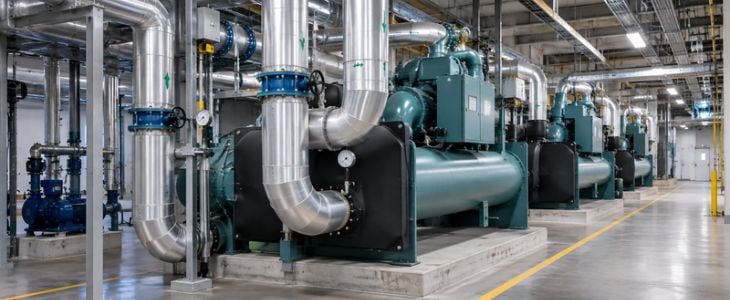
District Cooling Technology
District cooling technology implies a centralized cooling plant that distributes cooling via a chilled-water distribution network to multiple buildings and users as part of a service based on energy distribution.
While district cooling technology as a technical architecture model can be employed for other purposes, it represents yet another option to enable Cooling-as-a-Service.
What Factors Influence Cooling Performance in CaaS?
The business models for CaaS companies require being capable of continuously measuring, controlling and optimizing the cooling that is supplied.
In fact, for these companies, cooling efficiency, availability, maintenance, redundancy, monitoring and adaptation to demand are core aspects to their business, rather than mere add-ons or optional features.
In this context, the following factors should be considered when optimizing cooling performance in Cooling-as-a-Service projects:
Cooling Capacity and Supplied Cooling Energy
CaaS providers must differentiate between their cooling capacity and the thermal energy that they supply during a given time.
On the one hand, cooling capacity refers to the equipment or cooling plant’s capability to effectively remove heat from a space. A measure that is key for clients to choose the right cooling supplier, considering how it matches with the client’s actual cooling demand.
On the other hand, CaaS companies must also keep track of the volume of cooling energy that is supplied for a client, so that the billing process is accurate.
Supply and Return Temperatures
These two factors can have a significant influence in chilled-water cooling system operation.
In order to optimize performance, CaaS needs to address all potential issues regarding supply and return temperatures in water, as they can interfere with the system’s efficiency, performance, energy consumption and overall cooling capacity.
Energy Efficiency
To ensure the model performs as intended, CaaS companies must necessarily address and monitor the energy consumption required for cooling production. Because the less energy is consumed (and paid for) for cooling production, the better the economic results for CaaS companies.
Here, entities like The Global Innovation Lab for Climate Finance place Cooling-as-a-Service as capable of accelerating the “deployment of clean cooling technology at scale in emerging markets, by (...) aligning incentives for the most efficient operations and maintenance.”
Availability and Reliability
Cooling-as-a-Service providers’ performance is also measured considering their capacity to deliver the required cooling when the client needs it.
This positions cooling availability and cooling reliability as key aspects to measure CaaS performance, especially in certain applications and industries where even minor disruptions in cooling can cause significant issues (such as data center cooling, among other applications).
Performance Monitoring
Continuous cooling monitoring is at the heart of Cooling-as-a-Service, as it allows for verifying whether the cooling system is performing according to the terms of agreement, while also providing valuable data to optimize performance and efficiency from the business’ point of view.
Key Technical Requirements for CaaS Cooling Plants
Cooling Load Profile
A cooling plant built with providing Cooling-as-a-Service as a goal must take into consideration several factors surrounding the necessary cooling load profile, including:
- The base load that will be dealt with.
- Potential peak demand scenarios.
- The expected daily variations and seasonal variations.
- The strategy to deal with potential future demand growth.
This means the cooling plant should not be designed solely based on theoretical maximum cooling loads, but also taking into account the rest of the factors that have an influence on the plant’s load profile.
Chiller Configuration
When considering the right approach to incorporate chillers, the questions should revolve around the required number of equipment pieces, their capacity, their potential for working under partial loads and how to undertake chiller sequencing.
The guidelines for the environmental consideration of chillers can also be introduced in order to opt for the most sustainable solutions in terms of water use, refrigerant choices and power consumption.
Heat Rejection
When designing a cooling plant, producing chilled water is just one part of the equation, as how to solve heat rejection should also be considered.
Depending on the project’s needs and potential, the strategies for heat rejection can range from cooling towers and dry coolers, to direct condensation techniques or ambient conditions.
Redundancy
The question on how to guarantee cooling availability and redundancy also plays a key role in the technical requirements for CaaS, so that solutions must consider how service will be assured during maintenance operations or in the event of equipment failure.
Scalability
Finally, Cooling-as-a-Service infrastructure must also address the plant’s capacity to adapt in case cooling demand grows.
Thermal Energy Storage in Cooling-as-a-Service: An Opportunity for Better Efficiency
Thermal Energy Storage (TES) represents a key opportunity for cooling plants dedicated to Cooling-as-a-Service.
TES systems allow for partially decoupling cooling production from cooling demand. In practice, this means cooling capacity can be produced and stored at different times, and then supplied when needed.
This possibility opens the door to both performance and financial advantages, with cooling production taking place during off-peak hours or when it’s most cost-effective.

What to Consider for Monitoring and Optimization in CaaS
Monitoring and optimization efforts in CaaS initiatives represent fundamental issues for the functioning of a plant, and the following parameters and strategies must be taken into account for achieving both:
- Technologies for real-time monitoring, including sensors, smart metering and automated controls, so that cooling control doesn’t depend on manual efforts.
- Chiller sequencing strategies, which involve the staged functioning of chillers depending on actual cooling demand in the real time.
- Variable-speed operation, which allows for a dynamic adjustment of equipment speed that responds to real-time conditions and needs.
- Predictive cooling system maintenance in order to minimize risks and solve issues before they materialize or cause a significant impact by analyzing captured data at the plant.
- Performance tracking so that opportunities for optimization are detected.
Why Continuous Optimization Matters for Operational Efficiency
In cooling plants, design efficiency does not guarantee operating efficiency. Because working loads and operational conditions are dynamic and can evolve over time, cooling system operation must be continuously monitored and optimized in order to guarantee top performance.
This is especially true for Cooling-as-a-Service models, where top performance across the equipment’s whole lifecycle represents a key factor for business profit.
When Does Cooling-as-a-Service Make Technical Sense?
Cooling-as-a-Service is not a one-size-fits all solution that universally provides value for all types of projects. Instead, it’s particularly well-suited for facilities with:
- Significant and predictable cooling demand, with providers being able to supply cooling adjusted to that demand.
- Long operating hours, considering how this type of cooling often involves high-capacity cooling systems with significant upfront costs. Instead, CaaS transforms that capital expense into operational expenses that are directly tied to the client’s actual cooling demand. The Climate Finance Lab also points out how, in CaaS, “the technology provider is incentivized to install and maintain the most efficient equipment possible”. In turn, clients are then able to benefit from the supplier’s efforts towards efficiency.
- High availability requirements, as contracts with CaaS companies often involve cooling availability guarantees and offer continuous monitoring and support.
- Centralized cooling opportunities, so that clients can access the benefits of this type of cooling infrastructure but outsource its implementation, operation and maintenance.
- Limited Operations & Maintenance (O&M) capabilities, as CaaS companies allow clients to delegate operational and maintenance tasks to specialized teams and ad-hoc technologies.
- Changing or growing cooling loads, by choosing CaaS companies that offer scalability and flexibility.
- Potential for efficiency optimization, with Cooling-as-a-Service being capable of providing access to innovative and efficient cooling infrastructure without the need for upfront investment.
As such, Cooling-as-a-Service can represent a valid option for a large range of industries and sectors in need of cooling, from industrial facilities, to commercial developments, campuses, district cooling networks or data centers, among others.
From Cooling Equipment to Cooling Performance: The Heart of Cooling-as-a-Service Design
The technical models that support Cooling-as-a-Service allow both providers and clients to move beyond questions around what cooling equipment should be purchased.
Instead, the conversation can move to include more sophisticated considerations regarding what cooling performance the facility requires and how it can be delivered efficiently throughout the system's lifecycle.
In this context, ARANER’s expertise in delivering tailored cooling solutions proves highly valuable.
From centralized cooling plants, to district cooling, Thermal Energy Storage and solutions for energy optimization, we put our thermal engineering experience to work to find the right solution for each project, including Cooling-as-a-Service initiatives.
Get in touch with us to take the first step toward Cooling-as-a-Service.

FAQs about Cooling-as-a-Service
What is Cooling-as-a-Service (CaaS)?
Cooling-as-a-Service is a model for service provision that allows for outsourcing cooling by shifting ownership, operation, and maintenance of cooling infrastructure to a service provider.
How does Cooling-as-a-Service work?
Cooling-as-a-Service works by delegating the production and distribution of cooling to a specialized cooling plant, which then measures the supplied cooling in order to bill for their services.
What do CaaS companies provide?
CaaS companies’ services include producing and distributing cooling, as well as measuring the services provided. As part of these operations, they are also in charge of the maintenance and operational tasks required to ensure the service is provided according to the agreed standards.
What is the difference between Cooling-as-a-Service and district cooling?
Cooling-as-a-Service represents a model for service provision, while district cooling technology refers to a specific technical architecture model that can be tied to CaaS or not.
How is cooling performance measured in a CaaS model?
Cooling performance is measured by introducing technologies for continuous monitoring and measurement, including sensors for collecting data, and data analytic technologies.
Can Thermal Energy Storage be integrated into Cooling-as-a-Service?
Yes, Thermal Energy Storage can represent a key addition to Cooling-as-a-Service cooling plants, opening the door to increased efficiencies and optimization.








 LINKEDIN
 YOUTUBE