
Large heat pumps in district heating systems are becoming a key technology in the energy transition. While district heating is a century-old concept, today’s networks are evolving thanks to large-scale heat pumps, enabling more efficient and low-carbon heating solutions.
Modern DH customers demand three things: reliability, affordability, and easy control and optimization. At the same time, utilities are under pressure to drastically reduce CO₂ emissions while maintaining security of supply.
To meet these challenges, large-scale heat pumps have emerged as one of the most effective technologies for transforming traditional district heating into a low-carbon, future-proof energy system.

Why are large heat pumps important for district heating?
Large heat pumps are important because they:
-
Reduce CO₂ emissions
-
Improve energy efficiency
-
Enable renewable energy integration
-
Lower operating costs
-
Stabilize energy prices
District heating systems are increasingly shifting away from fossil-fuel-based boilers toward electrified and renewable heat generation technologies. Organizations such as Euroheat & Power and the International Energy Agency (IEA) consistently identify large heat pumps as a cornerstone technology for decarbonizing district heating networks.
-
Large heat pumps allow DH systems to:
-
Recover and upgrade low-grade heat
-
Reduce primary energy consumption
-
Lower operating costs
-
Integrate renewable electricity
-
Stabilize energy prices
-
Reduce CO₂ emissions
At ARANER, large-scale heat pumps are a key element of integrated district heating solutions designed to meet long-term sustainability targets.
What Are Large Heat Pumps?
A heat pump is a system that uses external energy—typically electricity—to transfer heat from a low-temperature source to a higher-temperature sink.
A heat pump is considered large-scale when its capacity exceeds 1,000 kW (1 MW). Depending on technology and compressor type, large heat pumps can reach capacities of 20–30 MW and deliver outlet temperatures of 90–100°C, making them suitable even for high-temperature district heating networks.
Why Large Heat Pumps are highly efficient
Industrial heat pumps achieve very high efficiency, expressed as Coefficient of Performance (COP), especially when the temperature difference between the heat source and the heat sink is low.
They use a refrigerant cycle to:
-
Absorb heat in the evaporator
-
Upgrade it through compression
-
Release useful heat in the condenser
How do Large Heat Pumps work in District Heating?
Large heat pumps operate mainly using two thermodynamic cycles:
Vapor Compression Heat Pumps
This is the most common technology in district heating applications.
The vapor compression cycle includes:
-
Evaporator
-
Compressor
-
Expansion valve
-
Condenser
It is widely adopted due to its:
-
High efficiency
-
Operational flexibility
-
Broad capacity range
-
Maturity and reliability
Absorption Heat Pumps
Absorption heat pumps are driven by thermal energy instead of electricity and use working pairs such as:
-
Water / ammonia
-
Lithium bromide / water
While effective in specific applications, vapor compression heat pumps remain more common in DH systems due to higher performance and easier integration.
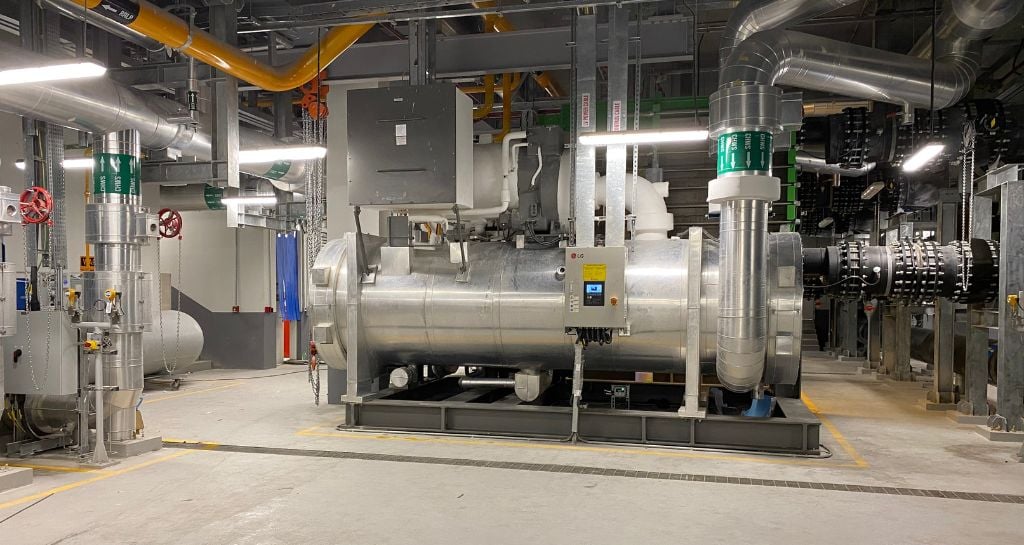
Why are Large Heat Pumps a perfect fit for District Heating?
Large-scale heat pumps are particularly well suited to district heating because they can upgrade locally available low-grade heat sources into valuable thermal energy.
Typical Heat Sources
-
Waste heat from industry or data centers
-
Sewage water
-
Groundwater
-
Rivers, lakes or seawater
-
Excess heat from cooling systems
By using electricity—ideally from renewable sources—large heat pumps significantly reduce fossil fuel dependency.
Combined Heating and Cooling Benefits
When heating and cooling demands exist simultaneously, large heat pumps can:
-
Recover waste heat from cooling processes
-
Supply district heating
-
Dramatically increase system-wide COP
This makes them ideal for district heating and cooling networks, industrial zones and urban developments.
Large Heat Pumps vs conventional boilers in District Heating
Compared to conventional boiler systems, industrial heat pumps offer:
-
Much lower CO₂ emissions
-
Higher overall efficiency
-
Reduced reliance on primary energy
-
Better integration with renewables
With supply temperatures up to 90–100°C, large heat pumps can support even traditional DH networks. The transition toward 5th Generation District Heating, with supply temperatures around 60°C, will further increase their efficiency and attractiveness.
How to select the best Large Heat Pump for a District Heating System
Selecting the right large heat pump requires a detailed engineering assessment.
1. Availability of Heat Sources
The heat source must be:
-
Abundant
-
Reliable
-
Close to the DH network
Common sources include sewage water, groundwater and surface water.
2. System Design and Operating Strategy
Large heat pumps should be designed for:
-
Baseload operation
-
High efficiency at part load
-
Long annual operating hours
Peak loads are typically covered by:
-
Electric boilers
-
Biomass boilers
-
Gas or oil-fired boilers (as backup)
3. Refrigerant Selection
Common refrigerants include:
-
HFCs (e.g. R134a)
-
HFOs (e.g. R1234ze)
-
Natural refrigerants such as ammonia (R717)
Low or zero Global Warming Potential (GWP) is a key requirement.
ARANER designs systems that comply with local regulations while maximizing performance.
4. Compressor Technology and System Layout
-
Screw compressors (often for ammonia)
-
Centrifugal compressors (large capacities)
-
Two-stage designs for improved performance and reliability
The role of Heat Pumps in future District Heating (Smart Cities)
Future cities face a structural challenge: heat demand and heat supply are often spatially and temporally mismatched. This leads to energy waste unless systems are integrated intelligently.
Large heat pumps play a critical role in:
-
Smart city energy systems
-
Sector coupling (power–heat–cooling)
-
Integration with thermal energy storage
-
Flexible demand response
When combined with heat storage, large heat pumps enable advanced energy management strategies that align perfectly with smart city concepts promoted across Europe.
Importantly, they can be:
-
Integrated into existing DH networks
-
Installed as add-ons
-
Designed as stand-alone systems
Conclusion
Large-scale heat pumps are a cornerstone technology for the decarbonization of district heating systems. By leveraging waste heat and renewable electricity, they deliver high efficiency, flexibility and long-term sustainability.
As district heating networks evolve toward lower temperatures and smarter operation, large heat pumps, engineered and integrated by experts like ARANER, will play a central role in building resilient, low-carbon urban energy systems.

FAQs
What is a large heat pump in district heating?
A large heat pump in district heating is a system with a capacity above 1 MW that upgrades low-temperature heat sources into usable heat for district heating networks.
Why are large heat pumps important for decarbonization?
They reduce CO₂ emissions by replacing fossil-fuel-based heat generation and enabling the use of renewable electricity and waste heat.
What heat sources can large heat pumps use?
Typical sources include industrial waste heat, data centers, sewage water, groundwater, and seawater.
Are large heat pumps efficient?
Yes. They can achieve high Coefficient of Performance (COP), especially when temperature differences are low.








 LINKEDIN
 YOUTUBE