
The main difference between air-cooled and water-cooled chillers lies in how they reject heat. Air-cooled chillers use ambient air, while water-cooled chillers transfer heat through a water circuit, typically connected to a cooling tower.
Water-cooled chillers generally offer higher energy efficiency under comparable operating conditions, whereas air-cooled systems can reduce water consumption and simplify maintenance. However, choosing the right solution depends on cooling capacity, climate, installation requirements and lifecycle costs.
Water availability is another critical factor. As highlighted in discussions around global water scarcity, including those referenced by the World Bank, the relationship between water and energy consumption is becoming increasingly important. This water-energy nexus must also be considered when evaluating cooling technologies for industrial facilities and large-scale cooling plants.
The following table summarizes the main differences between air-cooled and water-cooled chillers, comparing their energy efficiency, water consumption, installation requirements, maintenance and costs.
| Factor | Air-cooled chiller | Water cooled chiller |
| Heat rejection | Ambient air | Water circuit, typically connected to a cooling tower |
| Energy Efficiency | Depends strongly on outdoor dry-bulb temperature | Often higher under comparable conditions |
| Direct water consumption | Generally negligible for dry air-cooled configurations | Requires make-up water in evaporative tower systems |
| Installation | Generally simpler | Additional equipment and infrastructure |
| Maintenance | Typically lower system complexity | Requires water treatment and tower maintenance |
| Initial investment | Often lower system installation cost | Often higher total installation cost |
| Operating costs | Influenced by electricity consumption | Influenced by electricity, water and treatment costs |
| Suitable applications | Water-constrained sites and various industrial cooling loads | Facilities where efficiency gains justify the additional infrastructure |
What is a chiller?
A chiller is a cooling system designed to remove heat from a liquid, typically water or a water-glycol mixture, and transfer it to the surrounding environment through a refrigeration process. The cooled liquid is then circulated to equipment or processes that require temperature control.
Chillers are widely used in industrial facilities, power plants, district cooling systems and commercial buildings. Depending on how they reject heat, they are generally classified into two main categories: air-cooled chillers and water-cooled chillers.
The main difference between these technologies lies in their heat rejection method, which influences energy efficiency, water consumption, installation requirements and maintenance costs.

What is a Water-Cooled Chiller?
Water cooled chiller systems have a cooling tower, thus they feature higher efficiency than air-cooled chillers. Water cooled chiller is more efficient because it condense depending on the ambient temperature bulb temperature, which is lower than the ambient dry bulb temperature. The lower a chiller condenses, the more efficient it is. This system has several essential components including:
- Cooling towers
- Condenser water pumps
- Make-up water pumps
- Chillers
- TES reservoirs
Advantages of water-cooled chiller
Some users may prefer these chillers because of the smaller size they occupy as compared to air-cooled chillers. These chillers also feature higher efficiency and last longer than the mentioned alternative. Those who would like the equipment to be placed indoors may find the water-cooled machine desirable.
Discover: Chilled Water System on your next project: save up to 40% of energy
In The Evaporator
The role of the evaporator is to produce chilled water. The device releases the water at about 6°C (42.8°F) and pushes it throughout the facility with the help of a pump. A network of pipes passes the chilled water through every necessary section of the building. After exchanging coldness with room air, which blows across the Air Handling Units (AHU’s) and fan coil units (FCU’s), the water is now warmer at about 12°C (53.6°F). It returns to the evaporator where the refrigerant absorbs the unwanted heat and directs it to the condenser. The chilled water is cool once again and it can now continue to cool the facility. Note how this is called “chilled water” throughout no matter the temperature.
In The Condenser
A refrigerant brings unwanted heat from the evaporator and passes through the condenser. There is another loop connected to the condenser- the condenser water loop, which is between the cooling tower and the condenser. After entering the condenser at about 27°C (80.6°F), the water leaves at 32°C (89.6°F) and heads to the cooling tower. Note that at no time do the refrigerant and the condenser contact directly. Heat exchange is only through a pipe wall. The condenser water, with the unwanted heat, goes to the cooling tower for further heat rejection.
In The Cooling Towers
This is where the unwanted heat in a facility ends up. A large fan feeds the unit with air. The air meets with the oncoming condenser water. From the direct contact, the condenser water loses heat to the air. The condenser water goes back to the condenser the cycle continues. These open-topped devices come in many designs depending on many factors.
Examples are cross flow, counter flow, natural draft and mechanical draft. Stay with us for coverage of these designs in upcoming posts. This is a good way of settling the cooling tower vs. chiller confusion. However, if you still need more details about the water-cooled chiller components and operation, reach out to our team and you will get help. Now, compare it to the air-cooled chiller discussed below.
What is an Air-Cooled Chiller?
Where aesthetics and environmental conditions or water access restrictions exist, the air-cooled chiller may be applied. Both air-cooled chiller and water cooled chiller depend on an air stream as a means of heat transfer. The difference is that the water-cooled chillers or rather the cooling towers use a humid air stream (ambient air stream + water spray) while the air-cooled chillers use a current of ambient air.
Normally water-cooled chiller is cheaper and more efficient, with the disadvantage of high water consumption. ARANER has found a way of combining modern manufacturing methods and advanced technology to achieve highly effective and efficient air-cooled chillers. Owing to that, the company’s chiller plants are very competitive to water chilled chillers in different aspects. For example, these plants are very impressive in terms of footprint, efficiency, and noise. Unfortunately, some people still believe that air-cooled chillers cannot offer quite good efficiencies. What such people only need to check is the performance of these chillers two decades ago is the progressive increase in NPLV rating of air-cooled chillers over the years.
Already, many chiller plants in the Middle East and elsewhere have adopted ARANER’s air-cooled designs and have expressed satisfaction. When used in part-load applications, these chillers are very reliable.
Advantages of Air-Cooled chiller
- No cooling towers
- Better environmental stability-no water wastage
- Low maintenance costs
- Easier to operate and control-tower freezing and tower bypass absent
- Chemical costs avoided
- Water costs avoided, especially in cities
- No water problems to deal with in case of disaster
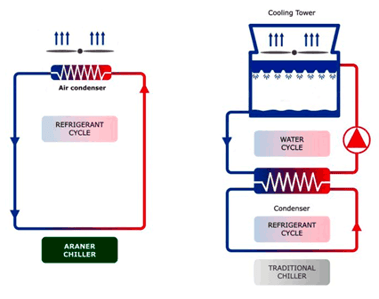
Fig 1: Air-Cooled Chilled Alongside Water Cooled (Traditional) Chiller
When to choose each type?
The cooling capacity is the main guideline for the choice of the chiller. Equally crucial is the balance between operating costs and capital costs. Some clients will base their buying decision on initial costs. However, a value-based option considers both operational cost and initial cost. To determine the initial cost of each option, add the costs for both contractors and equipment. For the water-cooled chiller, remember to add cooling tower.
When it comes to life cycle cost, you have to consider both purchase cost and operating cost. When you evaluate each of the two chillers this way, you are able to determine its total cost. What you must note is that water-cooled chillers normally appear more valuable if you ignore first cost and water cost. However, it is only after you look at the broader costs that the true picture appears clearly.
Hybrid chillers: a flexible alternative
Hybrid chillers are chillers that can operate as air-cooled chillers under certain conditions and water-cooled chillers under other conditions. They are an interesting alternative for areas with a predominantly dry climate and low water availability. Also, when water availability is not constant or reliable.
It might interest you: Environmental Consideration of Chillers for District Cooling Plants
Water-cooled chiller and air-cooled chiller, the main advantages!
Choosing between an air-cooled and a water-cooled chiller depends on several factors, including cooling capacity, energy efficiency, water availability, installation requirements and long-term operating costs.
While water-cooled chillers often provide higher energy efficiency, air-cooled systems offer advantages in terms of water consumption, installation simplicity and maintenance. The best solution ultimately depends on the specific requirements of each project.
At ARANER, we develop customized cooling solutions tailored to the technical and operational needs of each facility. Contact our team to discuss your project and explore the most suitable cooling technology for your application.

FAQs – Water Cooled vs Air Cooled Chiller
Which is more efficient: water cooled or air cooled chiller?
Water-cooled chillers generally offer higher energy efficiency because cooling towers can reject heat at temperatures closer to the ambient wet-bulb temperature. However, overall efficiency depends on climate, cooling load, operating conditions and the energy consumed by auxiliary equipment such as pumps and cooling tower fans.
Which chiller is better for water-scarce regions?
Air-cooled chillers are generally preferable in water-scarce regions because conventional dry air-cooled systems do not require water for heat rejection. This makes them particularly suitable for facilities where water availability, consumption restrictions or water treatment costs are major concerns.
Are water-cooled chillers more expensive than air-cooled chillers?
Water-cooled chiller systems typically involve higher initial installation costs due to additional equipment, including cooling towers, pumps and water treatment systems. However, their higher energy efficiency can reduce electricity costs. The most economical solution depends on the total lifecycle cost, including energy, water, maintenance and initial investment.
When should I choose an air-cooled chiller?
Air-cooled chillers are a suitable option when water availability is limited, installation simplicity is a priority or reducing maintenance requirements is important. They can be used in both small and large-scale facilities, although their performance depends on ambient temperatures and cooling demand.
Do air-cooled chillers require less maintenance than water-cooled chillers?
Air-cooled chiller systems generally require less maintenance because they eliminate the need for cooling towers, condenser water pumps and associated water treatment. However, regular maintenance of coils, fans, compressors and other components remains essential to ensure reliable operation.








 LINKEDIN
 YOUTUBE