
Industrial refrigeration is not simply large-scale air conditioning. It is a complex discipline involving advanced technologies designed to remove heat from industrial processes, materials or environments with high precision, reliability and energy efficiency.
Because many industrial processes depend on strict thermal control, industrial refrigeration plays a central role in product quality, operational safety, environmental performance and overall process productivity. From chilled water plants to absorption chillers and seawater-cooled systems, these cooling solutions are engineered to maintain stable temperatures under demanding conditions and at massive scale.
Organizations such as ASHRAE (American Society of Heating, Refrigerating and Air-Conditioning Engineers) and the International Institute of Ammonia Refrigeration (IIAR) have helped shape industry standards, improving the safety, performance and sustainability of refrigeration systems worldwide.

What is Industrial Refrigeration?
Industrial refrigeration refers to the equipment, technologies and control strategies used to extract heat from industrial processes or environments. Unlike comfort cooling, these systems must:
-
Manage high cooling loads
-
Maintain specific temperature setpoints
-
Operate continuously
-
Provide high accuracy and stability
-
Adapt to diverse industrial scales
Industrial refrigeration technologies include:
-
Compression refrigeration cycles
-
Absorption chillers
-
Chilled water production plants
-
Seawater-cooled systems
-
Hybrid cooling with heat recovery
The evolution of industrial refrigeration has been essential for sectors such as Food & Beverages, Pharmaceuticals, Petrochemicals, Power Generation, Metallurgy and Data Centers, enabling consistent product quality, safer processes and more stable operations.
Organizations like Eurovent Association and the Cooling Technology Institute (CTI) continue to provide guidelines and performance standards that strengthen the industrial cooling sector globally.
What are the main applications of industrial refrigeration?
Industrial refrigeration is used in district cooling, electricity generation, chemical and petrochemical processing, pharmaceutical manufacturing, food and beverage production, data centers and other heavy industries. It ensures precise temperature control, product preservation, equipment protection and safe operating conditions.
1. District Cooling
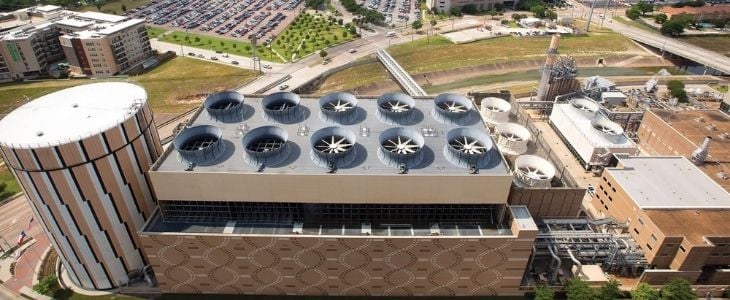
District cooling systems distribute chilled water from a centralized plant to multiple buildings—such as hotels, residential developments, airports or business complexes—to ensure stable indoor comfort regardless of outdoor temperature.
Benefits of District Cooling
Centralizing cooling production yields:- Higher overall system efficiency
- Lower operating and maintenance costs
- Reduced capital expenditure per building
- Significant peak-load reduction when combined with thermal energy storage
- Improved environmental performance
It may interest you: District Cooling system advantages: its Superpowers
Technologies Used
Depending on water availability and local energy conditions, district cooling may use:- Cooling towers
- Direct or indirect condensation systems
- Geothermal chillers
- Seawater-cooled systems
2. Electricity Production
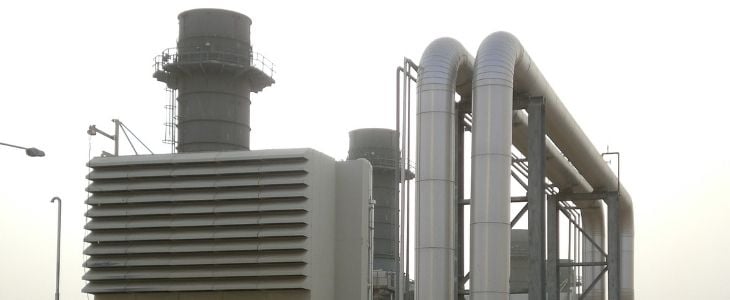
Power plants depend on stable inlet air temperatures to operate efficiently. When air entering gas turbines becomes too warm, its density decreases and power output drops significantly.
Electricity generation is often based on the combustion of different fuels. To achieve a higher efficiency, inlet air must be in determined conditions. If the temperature of the inlet air is too high, its density decreases, suffering a decline in the electric production. To avoid this problem, systems like Turbine Inlet Air Cooling System, a system in ARANER’s portfolio, are used to cool down these air streams.
Other parts of production and distribution systems, like electric generators or distribution plants, also generate heat when operating. To minimize maintenance operations, refrigeration systems are necessary. This refrigeration equipment is usually based on compression or absorption cycles.
Turbine Inlet Air Cooling (TIAC)
TIAC systems, such as those engineered by ARANER, cool turbine inlet air to boost performance during hot periods. This provides:
-
Increased output
-
Higher efficiency
-
Enhanced operational stability
Other components in the power generation chain—generators, transformers and substations—require cooling to prevent overheating, reduce wear, and lower maintenance frequency. Compression and absorption cycles are commonly used to maintain these optimal thermal conditions.
3. Chemical & Petrochemical
Although chemical and petrochemical reactions are not as strictly controlled as the reactions in the Pharmaceutical field, control of temperature is an important factor in reaching high efficiency in their transformations. Distillations, crystallizations or condensations are operations requiring the removal of heat; hence refrigeration systems are necessary to obtain their products. In chemical and petrochemical industries, large scale cooling plants are used in their processes. Due to the high flow required and the location of the industries, river water or seawater is used as refrigerant.
Compression cycles and absorption cycles are used to cool down the hot stream after the heat has been dissipated in the different operations. Moreover, since hot streams are also required in other parts of the process, heat exchangers are usually applied to heat these streams and maximize the efficiency of the operation.
It might interest you: Industrial Refrigeration: Everything You Always Wanted to Know
4. Pharmaceutical
The Pharmaceutical industry is based around operations where fulfilment of strict conditions is essential for the success of every process. Going further, many production procedures imply biological or biochemical reactions that only take place in strict conditions in which microbiological species generate chemical compounds at their maximum yield. This is why it is so important that Pharmaceutical firms develop their products in clean disinfected rooms.
The pharmaceutical sector demands extremely strict environmental and process control. Temperature impacts:
-
Biochemical reactions
-
Product purity
-
Microbiological stability
-
Storage integrity
-
Clean room conditions
Cooling Systems in Pharma
Pharmaceutical facilities typically use:
-
Central chilled water plants connected to clean rooms
-
Precision cooling for bioreactors and fermentation units
-
Controlled cold storage for strains and compounds
-
Gas/liquid cooling (oxygen, chlorine, ammonia)
-
Compressed air cooling for production systems
Standards issued by ASHRAE and guidelines shared by sector publications like Refrigeration Industry Magazine support the reliable implementation of these systems.
Discover: Energy management in pharmaceutical industry
5. Food & Beverages
The F&B industry relies on strict thermal management to maintain product safety and extend shelf life. Temperature is essential during processing, preservation and distribution.
Cooling During Processing
Chilled water is the preferred cooling medium due to its safety in case of leakage and its high ability to absorb heat from biological and chemical reactions.
Cooling for Storage and Freezing
After processing, products such as meat, dairy, fish or frozen goods require temperatures below 0°C.
For these applications: Compression refrigeration and absorption refrigeration are used with refrigerants that offer strong cooling performance and safe handling characteristics.
Refrigeration ensures:
-
Food safety
-
Prevention of contamination
-
Optimal product quality
-
Compliance with international standards
Keep reading: Chilled Water System on your next project: save up to 40% of energy
6. Data Centres
Data centers produce substantial amounts of heat through continuous server operation. Without proper cooling, temperatures rise rapidly, leading to equipment damage and service disruptions.
Cooling Approaches
Depending on design and climate, facilities use:
-
Air-based cooling (CRAC units, CRAH units)
-
Liquid cooling (chilled water loops, rear-door heat exchangers)
-
Seawater cooling for coastal data centers
-
Free cooling when environmental conditions allow
Effective cooling strategies reduce energy consumption, improve redundancy and support high-density computing environments.

7. Other industrial applications
Industries such as naval, metallurgical, mining, semiconductor manufacturing, automotive and heavy industry also depend on industrial refrigeration to:
-
Avoid equipment overheating
-
Maintain safe working environments
-
Protect process stability
-
Reduce operational costs
-
Extend asset lifespan
Customized cooling engineering is essential to prevent long-term failures, energy waste and unplanned downtime.
Why Industrial Refrigeration Matters
Industrial refrigeration supports:
-
Product safety and quality
-
Process efficiency
-
Operational continuity
-
Equipment protection
-
Environmental sustainability
Tailor-made refrigeration systems - like the ones developed by ARANER - provide high reliability, reduced energy consumption and optimal thermal performance across diverse industries.









 LINKEDIN
 YOUTUBE